

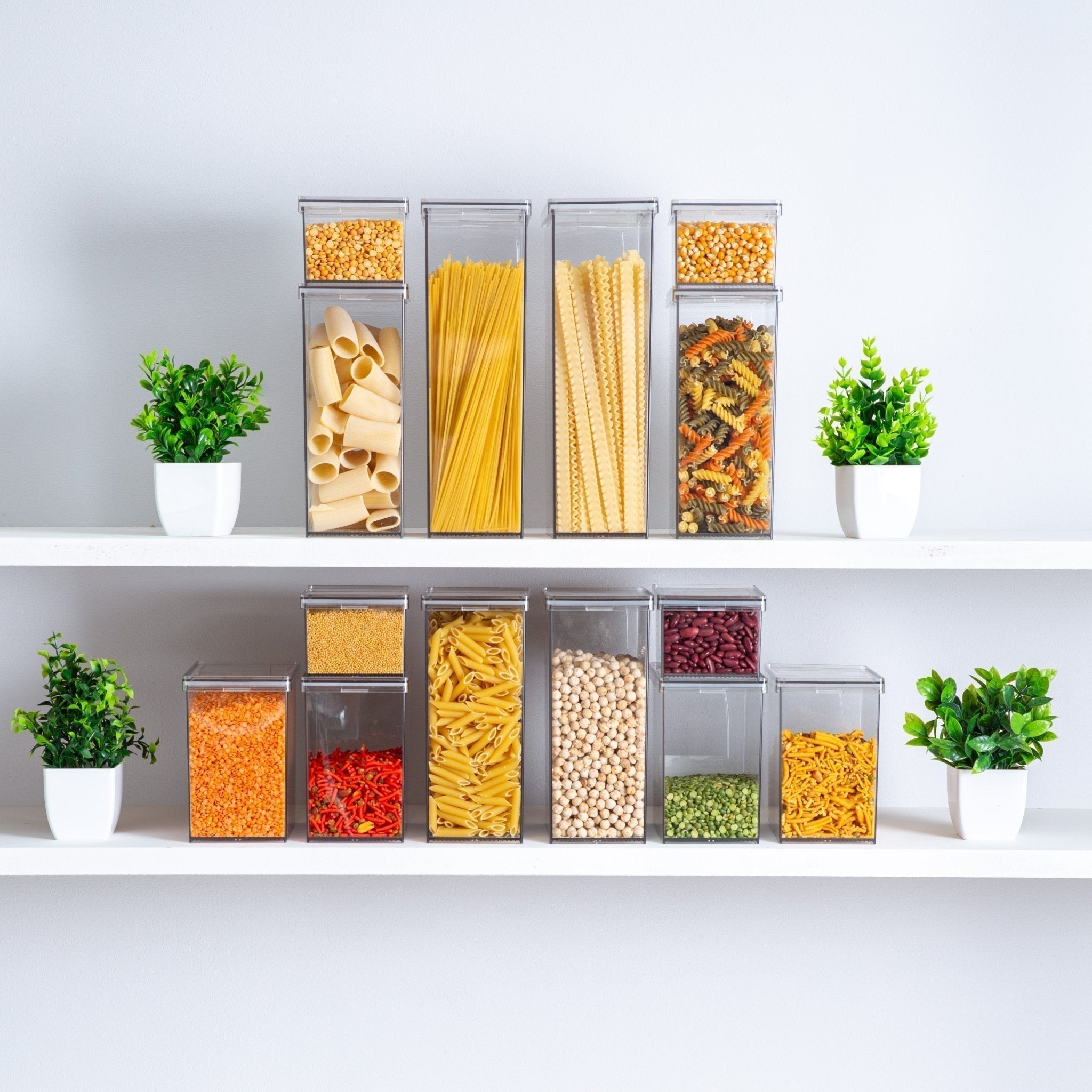
One of the simplest and most effective ways to keep pantry food fresh for longer is to transfer dry goods into airtight food storage containers shortly after opening. Air, moisture, and pests are the three things that quietly shorten the life of almost every dry ingredient in your cupboard. Move your flour into a properly sealed, BPA-free container and it can stay fresh for 8 to 12 months. White rice, which already stores well, can last for several years when kept airtight in a cool, dark spot. For most pantries, the switch takes less than ten minutes and saves you from throwing away expensive ingredients that have gone stale unnoticed.
This guide covers why air damages dry goods, which foods to prioritise, which container sizes you actually need, and how to set up a clear pantry canister system that stays organised without constant maintenance.
In this guide
- Why air shortens the shelf life of dry goods
- Which pantry foods need airtight storage?
- How to set up your pantry canister system in 5 steps
- What size airtight canister do you need?
- What are the most common pantry storage mistakes?
- Frequently asked questions
Why does air shorten the shelf life of dry goods?
Three things work against unsealed pantry food: moisture, oxygen, and pests.
Moisture is the most immediate problem. Even ordinary household humidity causes flour to clump, biscuits to soften, and cereal to lose its texture within days of the original packaging being opened. An airtight seal keeps humidity out and holds the dry environment the food needs.
Oxygen drives a second process called oxidation. The natural oils in nuts, seeds, whole grains, and wholemeal flour react with oxygen over time and turn rancid. This is why a bag of mixed nuts bought in January can smell unpleasant by March, even if it has not been near moisture. A sealed canister slows oxidation significantly.
Pests are the third threat. Pantry moths, weevils, and flour beetles can chew through cardboard packaging and paper bags with no difficulty. A canister with a proper silicone-sealed lid stops them entirely and means you will not open a bag of pasta to find something has already been there before you.
Which pantry foods need airtight storage?
Not everything in the cupboard needs a canister, but the foods below benefit meaningfully from proper airtight storage. The shelf-life figures below assume a cool, dark cupboard. For most dry goods, the main benefit is protection against humidity, pests, and odour transfer rather than a dramatic extension of shelf life.
| Food | In original packaging | In an airtight canister |
|---|---|---|
| Plain (white) flour | 6 to 8 months | 8 to 12 months |
| Wholemeal flour | 1 to 3 months | 3 to 6 months |
| White rice | 1 to 2 years | Several years when stored correctly |
| Dried pasta | About 2 years | About 2 years (airtight protects against pests, humidity and odour) |
| Rolled oats | 6 to 12 months | Up to 12 months (cool, dark storage) |
| Nuts and seeds | 1 to 3 months | 3 to 6 months (prone to rancidity, airtight storage makes the biggest difference here) |
| Granulated sugar | Indefinite, but clumps | Indefinite, stays free-flowing |
| Ground coffee | Stales quickly after opening | Airtight slows staling. For best flavour, use within a few weeks of opening regardless. |
| Cereal | Goes stale within 1 to 2 weeks open | Several weeks, depending on type and storage conditions |
Prioritise whichever ingredients you buy in bulk, use slowly, or find most frustrating to waste. Flour, oats, and nuts are usually the biggest wins. One thing we hear regularly from customers is how surprised they are by how much fresher nuts and seeds stay once they're transferred into airtight canisters. It is one of the changes customers notice almost immediately after making the switch.

Ideal for nuts, seeds, ground coffee, and baking spices. BPA-free, food-safe, clear walls with a silicone-sealed lid. Stackable with the full Fitt. range.
How do you set up a pantry canister system in 5 steps?
A canister system works best when it is consistent. Follow these steps once and the result will maintain itself with very little effort.
Step 1: Empty and audit your pantry. Pull everything out and check use-by dates. Discard anything that has expired or smells off. Donate anything you bought with good intentions but have not touched in six months. This is the only genuinely time-consuming part of the process.
Step 2: Group ingredients by how often you use them. Daily staples (flour, rice, pasta, oats, coffee) go at eye level or easy reach. Baking extras (icing sugar, cocoa, dried fruit) go on a higher shelf. Nuts and seeds, which you likely use in smaller quantities, can go towards the side.
Step 3: Match each ingredient to the right canister size. The sizing guide in the section below will help here. As a starting point: a 1.5 kg bag of plain flour fits neatly into the XL (3.3 L), a 500 g bag of rice fits into the Medium (1.7 L), and a 200 g bag of mixed nuts fits into the Small (0.75 L). One thing we hear regularly from customers is that the flour sizing surprises people: a standard 1.5 kg bag genuinely needs the XL, not the Large, and it is worth double-checking before you order.
Step 4: Decant and label. Transfer each ingredient from its original bag into the canister. A chalk label or a piece of masking tape with the ingredient name and the date written in marker is all you need. You do not need a label printer to make this work.
Step 5: Use the FIFO rule for top-ups. First in, first out. When you buy a new bag of flour, tip what remains into the new bag first so the older product is always used first. This one habit prevents the quiet staleness that builds up at the bottom of containers.

What size canister do you need for each pantry ingredient?
Choosing the wrong size is the most common mistake people make when switching to canisters. Too small and you end up leaving part of a bag unsealed. Too large and every canister looks half empty, which makes it harder to gauge when you are running low.
Here is a practical size guide based on standard UK supermarket pack sizes:
- Small (0.75 L): 200 g mixed nuts, 200 g seeds, a 100 g pack of ground coffee, a 200 g tin of cocoa powder, or small baking extras like whole spices and vanilla pods.
- Medium (1.7 L): 500 g basmati or long-grain rice, 500 g rolled oats, 500 g dried lentils or chickpeas, or 400 g brown sugar.
- Large (2.5 L): 1 kg of pasta (short shapes like penne or fusilli), 1 kg of granulated sugar, or 500 g to 1 kg of plain flour.
- XL (3.3 L): 1.5 kg of plain flour, 1.5 kg of pasta, 2 kg of white rice, or a 750 g bag of granola or muesli.
If you are unsure which sizes to start with, the Fitt. range is available in all four coordinated sizes, all BPA-free, food-safe, and designed to stack neatly so you can build out your setup over time without ending up with a mismatched shelf.

The most versatile size. Holds a 500 g bag of rice, oats, or brown sugar with room to spare. BPA-free, food-safe, clear walls, silicone-sealed lid. Stackable.

Built for bulk buys. Holds a full 1.5 kg bag of flour, a large box of cereal, or 2 kg of pasta. BPA-free, food-safe, stackable, and clear throughout.

What are the most common pantry storage mistakes?
Even with the right canisters, a few habits can undermine the system.
Leaving food in the original packaging. Resealable clips and folded-over bag tops are not airtight. They slow moisture ingress slightly, but they do not stop it. Once a bag is opened, the clock is ticking on quality.
Topping up without emptying first. Pouring new rice on top of old rice means the older product sits at the bottom indefinitely. Always empty the canister, check the remaining stock, then refill with the new bag underneath and the old on top.
Storing in a warm spot. Heat accelerates the spoilage process, particularly for oils and fats in whole grains, nuts, and wholemeal flours. Keep canisters away from the hob, the oven, and any wall that gets warm during cooking.
Choosing containers you cannot see through. Opaque tins look attractive, but a clear canister lets you check fill levels without opening it. When you can see at a glance that the flour is running low, you are much less likely to reach for the baking tin and find an empty canister at the wrong moment.
Buying a mismatched set. A pantry with canisters of different heights, materials, and lid styles looks chaotic and is harder to keep tidy. Choosing one stackable system in a few coordinated sizes creates a shelf that is genuinely satisfying to look at and easy to maintain.
Frequently asked questions
How long does flour last in an airtight container?
Plain white flour stored in an airtight container in a cool, dark cupboard will typically stay fresh for 8 to 12 months. In an opened paper bag, most guidance puts the figure closer to 6 to 8 months, so airtight storage gives you a useful buffer but is not a dramatic transformation for white flour specifically. Wholemeal and spelt flours, which contain more natural oils, last 3 to 6 months even sealed. Airtight storage makes a bigger difference here because it slows the rancidity that the extra oil content causes.
What dry foods should I store in airtight containers?
The biggest gains come from flour, rice, oats, sugar, cereals, and nuts. These are the foods most commonly wasted because of staleness, clumping, or pest damage. Dried pulses (lentils, chickpeas, beans) also benefit, though they have a naturally longer shelf life than grains. Whole spices can go into smaller sealed jars to preserve their aroma. We regularly hear from customers who are surprised by how much longer cereals stay crisp, and how much better nuts taste, once they have made the switch.
Can pantry moths get into plastic food storage containers?
Not if the lid forms a proper airtight seal. Pantry moths are persistent and will exploit any gap in folded bags, cardboard boxes, or loosely fitting lids. A container with a continuous silicone gasket around the lid edge creates a barrier they cannot breach. If you have ever found moths or weevils in your dry goods, switching to properly sealed canisters is one of the most effective ways to prevent a repeat.
Are plastic or glass airtight canisters better for pantry storage?
Both work well when the seal is properly designed. Clear plastic canisters that are BPA-free and food-safe are lighter, less likely to break if dropped, and generally easier to stack. Glass looks more premium on open shelves and does not absorb odours over time, which matters for strong-smelling ingredients like coffee or spices. For a closed pantry or shelved cupboard, quality clear plastic with a silicone-sealed lid is the practical choice for most households.
How do I know if a food storage container is truly airtight?
A genuine airtight canister has a continuous silicone gasket running around the inside edge of the lid, not just a friction fit. You should be able to feel slight resistance when pressing the lid on and a soft release when you open it. If the lid sits on loosely or there is no gasket, air and moisture can still enter around the rim.
Can airtight food canisters go in the dishwasher?
Always follow the manufacturer's care instructions for the specific product you have. In general, it is worth checking before putting lids through a hot dishwasher cycle, as heat can affect seals over time with repeated exposure. When in doubt, hand-washing the lid and machine-washing the body is a safe approach.
Ready to stop wasting food?
The Fitt. range comes in four sizes so you can match every ingredient in your pantry to the right canister. BPA-free, food-safe, stackable, and clear throughout.
Shop the Fitt. range →
Share: